


TO FIND OUT MORE ......
Prague was the beating heart of Bohemian baroque music in the 18th Century. Czechia born baroque violinist Lenka Torgersen tells Karen Yeung about the joys of discovering baroque music from her home country and highlights some of the most notable composers in the world of Bohemian baroque.
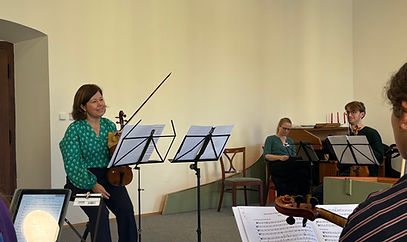
LT: Lenka Torgersen
LT: I feel happy and proud to play the works of my 18th Century baroque colleagues! I feel a strong affinity with music from this region. I am a member of Collegium Marianum Prague and the most important part of our research and concert activities is to discover works written by Czech composers - known and unknown. It is a pleasure to find and perform these works, especially because the level of the musical performances, compositions and instrumental skills of the musicians in the 18th century in Prague was extremely high, and there is still a lot of music yet to be discovered.
Music from Eighteenth-Century Prague
Count Morzin: Patron of the Arts
Count Václav Morzin (1676-1737) was a Bohemian aristocrat and a great patron of the arts, in particular music. Count Morzin established his own private orchestra, comprising some of Prague’s most accomplished musicians. The orchestra premiered many works by contemporary composers, including Haydn and Vivaldi.
Count Václav Morzin was a supporter and friend of the Venetian composer Antonio Vivaldi (1678-1741). Vivaldi wrote lots of music for Morzin's orchestra and Vivaldi dedicated the Four Seasons to Count Morzin.
The bassoonist of Count Morzin's orchestra was Anton Möser. Vivaldi dedicated his famous bassoon concerto RV496 to Count Morzin.
Bohemian musicians František Jiránek and Antonín Reichenauer both played in Count Morzin’s orchestra -they were both wonderful instrumentalists and composers.

Count Václav Morzin (1676–1737)

Antonio Vivaldi (1678-1741)
The bassoonist of Count Morzin's orchestra was Anton Möser. Vivaldi had composed the bassoon concerto RV496 dedicated for Count Morzin.
Charles VI
In 1723, Charles VI was crowned King of Bohemia and he became the governor of the Czech Estates during the Habsburg Empire era. Charles VI spent almost one year in Prague with the Viennese court. His stay in the city gave rise to many festive activities and artistic events such as orchestra concerts and operas.

Composers serving at the court of King Charles VI in Prague
Francesco Maria Veracini (1690-1768)
Antonio Caldara ( c. 1670-1736)
Giuseppe Tartini (1692-1770)
Silvius Leopold Weiss (1687-1750)
Johann Joseph Fux (1660-1741)
Johann Georg Pisendel (1687-1755)

Charles Burney (1726-1814) was an organist, composer, and the foremost music historian of his time in England, labelled Czechia as the conservatory of Europe.

